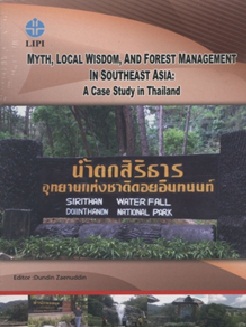
Myth, Local Wisdom, and Forest Management In Southeast Asia: A Case Study In Thailand
Thailand is a country in Southeast Asia that has fairly extensive tropical forests as part of a belt of tropical forests in Southeast Asia. However, Thailand experienced severe deforestation over the past three decades, especially during the last half century. The most severe forest damage occurred in three decades, from the years 1961- 1991, and was still continuing when the Thai government introduced a policy of export-oriented. Thus, it is not surprising that the forests in Thailand decreased dramatically from 60% in 1960 to just 30% in 2006. These conditions encourage the government of Thailand to issue anumber of policies to prevent more severe damage to forests. One of the policies is logging ban on natural forests (the logging ban policy) issued in 1989. Since then the Thai forest products changed from natural forest to Planted forests as an effort to run the program Reforestation of degraded forests. But efiort seems to be less successful because of on going forest destruction; The research is conducted in Chiang Mai, northern Thailand, there are dwell; managed forests by ethnic minorities, such as the Karen and Hmong, which has been there and live in harmony with the forest since ofyearsyago, The combination of indigenous knowledge with, social Community Forest Management (CFM) programs is a to manage forests sustainably. From this developed whether the values of local knowledge and efiective to manage the forest. This study uses on the dept interviews with stakeholders northern Thailand, in an effort to learn more of life of ethnic minorities in managing and conserving forests. In Addition, the interview also includes practitioners and academicians who have done similar studies to provide input on research.
Specifications
- Publisher: LIPI Press
- Language: English
- Year: 2012
- Author: Dundin Zaenuddin, Lamijo, Anang Hidayat