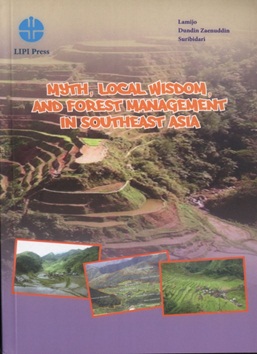
Myth, Local wisdom, and Forest Management in Southeast Asia
The Philippines is one country that has a tropical rain forest and experiences the worst deforestation in Southeast Asia. In the late 19th century, 70% of the total area ofthe Philippines was still covered by dense forest. However, it is now only about 20% remained. Deforestation's rate in the Philippines is estimated around 100,000 ha per year. Therefore, the Philippine Government needs to review the policy on environmental management, particularly forest areas by issuing BFM program or the Community Based Forest Management. This program not only aims to prevent deterioration of the forest damage occurred in the Philippine jungle, but also recognizes the existence of indigenous peoples living in the Philippines’ forest areas. One of the indigenous communities in the Philippines is lfugao in Cordillera region, Luzon. This community lives in the mountains and has a spiritual perception of the existence of the forest. Ifugao society has also developed a form of local knowledge in an effort to maintain and conserve forests and environment. Muyong and Payoh are two systems of forest management based on local wisdom in Ifugao community. Muyong is a local term meaning a collection of forest or wood. Meanwhile, the Payoh is a term that refers to arable land that can be irrigated by hydraulic or other techniques to prevent erosion. In addition, Muyong system can be viewed from different perspectives, both as a strategy for forest conservation, rehabilitation of water resource engineering, agricultural systems, as well as a form of natural regeneration improvement strategies.
Specifications
- Publisher: LIPI Press
- Language: English
- Year: 2010
- Author: Lamijo, Dundin Zaenuddin, Suribidari