Migration as Transnational Leisure: The Japanese Lifestyle Migrants in Australia

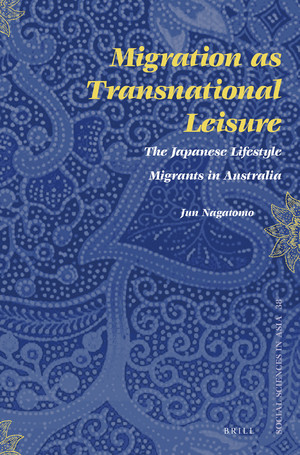
By Jun Nagatomo, Brill, 2014. 207 pages.
Living and pursuing career in Japan for some people, especially those who come from developing countries, seem to be attractive. Japan, which is frequently depicted in its popular cultures, as well as the government’s tourism campaigns as a beautiful country with great hospitality and unique culture, in fact, have serious problems in its society. Nagatomo’s book, on one hand, examines further the concept of ‘lifestyle migration’ (firstly utilized by Sato (2001)) on Japanese migrants in Australia, but on the other hand, also indicates in wider context the condition of contemporary Japanese society and workplace as well.
In his book on Japanese lifestyle migrants in Australia, Nagatomo organizes his work into three big parts. Firstly, he provides detailed literature review, introduction to the issue he focuses on as well as methodological and theoretical framework he uses. Secondly, he highlights the historical context and current circumstances of what is happening in contemporary Japan in regards to the emergence of Japanese outbound migrations. Thirdly, he discusses the current conditions as well as before-and-after imagination of ‘being a migrant in Australia’ of Japanese lifestyle migrants in Australia which he emphasizes as his findings
In the first chapter, Nagatomo provides the readers a background and significance of his study. He underlines the changing trend of migration of Japanese people to Australia since 1990s and what makes it different from other forms of international migration. For them, according to Nagatomo (2014) and Sato (2001), migration was a means of achieving their expected lifestyle, rather than being primarily motivated by economic success. To clarify this thesis, Nagatomo writes the detailed explanation on the historical and social context of sociocultural transformations which took place in Japan since 1980s, which may serve as background knowledge for his readers.
At that time, Japanese companies were facing great shifting in the workplace, including the massive retrenchment and the collapse of the famous lifetime employment system, due to an economic recession. This condition, in turn, paved a way to the changes in the Japanese work ethic and the rise of individualism both in workplace and society. The increasing stress and competition in Japanese workplaces, in particular, were then followed by the changing in leisure values of the Japanese people, from predominantly expensive-group oriented to more personalized and more budget-friendly and health oriented. In a wider context, Nagatomo argued that those transformations have influenced the Japanese’ values on lifestyle, that in the end, serve as driver to create a motivation for them to migrate to Australia.
Among thirty-one informants in his study, Nagatomo found various motivations to migrate ─what he labels as push and pull factors─ and post-migration experiences. Overall, Japanese lifestyle migrants have a tendency to escape from the stressful life in their home country. It is what he calls the ‘push factor’. On the other hand, they also have an initial premise that Australia provides a better life for them as a result of some information they have received about the country or the ‘pull factor’. Their previous experience as holiday-workers in Australia and the images they got from the tourism advertisements create this factor. Another core pull factor to consider is that they believe that Australia is more freedom and has more flexible lifestyle than Japan.
Moreover, as Nagatomo proposes that relationship between migration and leisure is understood though individuals’ experiences in both their place of origin and the receiving society, consequently, he provides the interesting findings showing that they sometimes find it hard to accept that their life in Australia is not necessarily better than in Japan. For those who work in Japanese enterprise in Australia and who have no English proficiency, being lifestyle immigrant in Australia somehow does not really meet their expectation. It is also interesting to note that most of the Japanese lifestyle migrants in this book still maintain a strong attachment to Japan when it comes to citizenship dilemma. The discrepancy between expectation and reality, according to Nagatomo, is another reason that makes Japanese migrants are strongly attached to Japan. Even for some of them, being overseas does not mean they should lose their ‘Japanese-identity’. Up to this point, Nagatomo wants the readers to understand how social facts shape action and how cultural elements constraint or facilitate patterns of action.
Nagatomo’s work in general, as the title indicated, introduces migration as transnational leisure as a new type of Japanese migration, in addition to the old ways of migration as economic, political, religious practices. He examines how “new lifestyle values” emerged out of the context of Japan’s social transformations, and how the emerging values among Japanese affected migration to Australia. In analyzing the emergence of value, he uses Weber’s perspective on the effect of value towards people’s actions. Moreover, in his book, he emphasizes that contemporary international migration is affected by globalization and transnationalism. Globalization and transnationalism, however, affect both leisure and tourism. In this book, it can be understood that the concept of leisure changes along with the change that occurred in its bigger sociocultural context.
Furthermore, Nagatomo emphasizes the strong linkage between Japanese lifestyle migrants’ values on leisure and ideal lifestyle, in contrast to the current condition in Japan, and their migration decisions as well as the process in life after migration. He finds that in the settlement life after migration, they still indeed have to adapt as they cannot directly settle down and living the life as same as the previously imagined as the ideal lifestyle.
Overall, this qualitative research enriches the theory of international migration by adding the “pursuing a lifestyle” as one of the key reason for migration. It provides rich information on the background context in both sides of Japan and Australia, the dynamic in settlement process, and even analysis on Japanese lifestyle migrants’ view on their Japanese-ness. Another interesting issue for me to consider in the further study is, therefore, to explore to what extent Japanese lifestyle migrants view their ‘Japanese-ness’ as like for example, overseas Chinese or Chinese diaspora see themselves.
Moreover, just like the famous Durkheim’s book (1897), Suicide (French: Le suicide), this work can also be seen in a similar pattern. In his book, Durkheim argues that the number of suicide does not only reflect the individual’s problems, but also the problems at the level of society. Nagatomo’s work, on the other hand, may provide a way of understanding a current state of a society, in this context, Japanese society, though the emerging concept of lifestyle migration, and vice versa, as the understanding of society and its sociohistorical context, may be a key factors to understand the lifestyle migration. (Firman Budianto/ Researcher of P2SDR-LIPI)