Exploring Taiwan Muslim-Friendly Tourism (Part 2)

Excursion visit to Tourist Attractions
It was undeniable that the most interesting part of this camp was the visit to some tourist attractions. In the first day of the camp, MOFA Taiwan hosted a dinner and welcoming party at The Grand Hotel Taipei. This hotel is really famous because it has served many important people from all over the world, including the President and Prime Minister from many countries. This hotel is one of the hotels in Taiwan that already has Muslim-Friendly Hotel certification from CMA. In Taiwan, there are several bodies that issue halal certificate, namely the CMA, Taiwan Halal Integrity Development Association (THIDA), and also by some mosques that have cooperation with CMA and THIDA (like Taipei and Kaohsiung Grand Mosque).
In the second day, the participants took the speed-train from Taipei to Kaohsiung, continued with a short-visit to Meinung folk village to learn about Hakka Culture and participate in umbrella painting activities. After that, we headed to the ten drums Ciaotou Creative Park, located at the area that was used to be a sugar factory in the past. We watched the drum performance that is pretty amazing. The 10 drums percussion group already won some awards, including Grammy Best World Album Awards.[i] In the afternoon the participants visited the Kaohsiung Grand Mosque to pray and talk with the Imam of the Mosque, continued to a dinner. The second-day dinner was really special because we had it at the Indonesian Restaurant in Kaohsiung that already got a Halal certificate from the CMA.
After dinner, some of the participants went out to check the Liouhe Night Market. This activity was actually not included as an official agenda of the camp. Nevertheless, because the night market is one of the must-see places in Taiwan, the participants spared their resting time to go there. We could find almost everything in the night market, but it famous for the foods. According to Mr. Tsai, 99% of the foods in the night market are not halal, but I was lucky because I found pineapple pie with a halal logo issued by the Taipei Grand Mosque in this market.
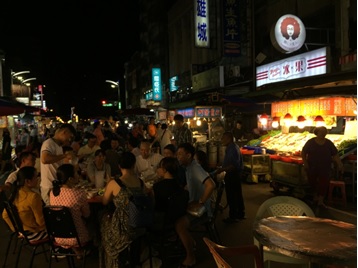
(Liouhe Night Market)
On the third day, we went to Pingtung where the local government hosted a welcoming reception for the participants. This event was also attended by some officials of the Pingtung County government and some representative of new immigrants and foreign workers from the Southeast Asian countries. Most of the new immigrants were the transnational wives of the Taiwan national citizen. They shared their stories about how they are included in the local government program, as a tour-guide for tourist from Southeast Asia. Ms. Sophia Pan, a new immigrant from Indonesia that took part in the program, explained that to be included in this program, she had to attend a special class about Taiwan culture, history and also about tourist attractions in Pingtung. They also have to pass the examination. Recently, more and more immigrants have been invited by the government to join the programs because Pingtung will host the Taiwan National Lantern Festival next year.
We also visited the Taiwan Indigenous People Cultural Park. The concept of this cultural park is similar with the Taman Mini Indonesia Indah, where we can enjoy traditional architecture, cultural products, art performance, and learn more about the diversity of Indigenous people from all over the country.
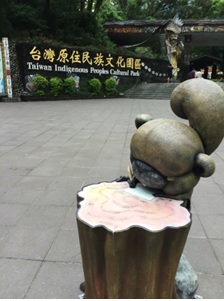
(Taiwan Indigenous People Cultural Park)
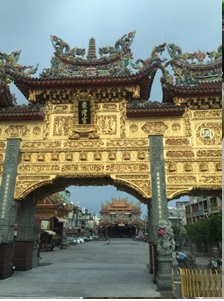
(Donglong Temple )
At The last day of excursion, the activity was started with cruising through the Dapeng Bay, one of the national scenic areas in Pingtung. It is the place where we can find the best quality of seafood in Taiwan. Besides, the participants also got an opportunity to visit the Donglong Temple and tasted the famous Bluefin Tuna of Dong-gang at one Muslim-Friendly Restaurant in Pingtung. The next stop was the Pier-2 Art Center located in the Kaohsiung Harbor area. Kaohsiung government utilized the abandoned warehouse in the Harbor and turned them into the art center. They invited many artists to open their studio and shop in this area. This place became art center of Kaohsiung, where many music concerts and art exhibition take place all over the years.
Muslim-Friendly Tourism in Taiwan
Ms. Alice Ko, the Executive Officer of Tourism Bureau, during her lecture, explained that one of the strategies under the Taiwan’s New Southbound Policy is to increase the number of tourist visits to Taiwan, especially from the ASEAN countries that are predominantly Muslim. For this purpose, the Taiwan Government has actively created a friendly and comfortable environment for Muslim. They have encouraged public transportation facilities and tourist attractions to built prayer rooms and washlet. As a result, many of the public spaces have been facilitated by such facilities, such as the Taoyuan International Airport, Kaohsiung International Airport, Taipei Main Station, Kaohsiung Main Station, Taiwan High-Speed Rail Taichung Station, and 13 National Scenic Areas all over Taiwan, while the other places will be gradually added to the list.
Alice Ko added that per July 2018 there were 181 hotels and restaurants in Taiwan that provide facilities to serve Muslim tourist. The Bureau has worked with CMA to issue certifications for restaurants that provide halal food, as well as to hotels and central kitchens. In addition to that, the Tourism Bureau has also provided subsidies for the acquisition of halal certification to encourage restaurants and hotels to improve or renovate their facilities to fulfill Muslim’s needs.
Since The Muslim population is minority in Taiwan, so most of Taiwanese are not familiar with Muslim culture. At the beginning, staffs of the Tourism Industry did not know how to serve Muslim tourists. With the help from CMA, the staffs in the tourism industry learnt about Muslim culture and how to provide appropriate service for Muslim tourists. More recently, the CMA created a special application called Halal Taiwan (Halal.tw). This mobile application provided information regarding the nearby location of Muslim-friendly Hotel, restaurant, halal shop, and also mosque or prayer rooms. We can download this useful application for free from the Apps store and Google Play.
Some Notes Regarding the Program
The lecture series and excursion have enabled me to gain a better understanding of Taiwan’s diverse culture. I learned a lot about the development of halal tourism and Muslim culture in Taiwan. I think the role of Taiwan government in creating friendly environment for Muslim deserves recognition, especially because Taiwan is not a region with Muslim-majority population.
Despite the very tight schedule, the Youth Exchange program was such an excellent event. It would be better if the schedule was arranged in a more-realistic way. Regarding the program, I personally think that it would be more relevant with the goal of the camp if we also have chances to take a look at the special kitchen for preparing halal foods and to talk with the owner or the manager of the Muslim-friendly Hotel or Restaurant (Researcher at P2SDR-LIPI)
[i] MOFA Taiwan. 2018. Taiwan Muslim Youth Exchange Camp for Southeast Asian Countries Program Book. Taipei: MOFA Taiwan