Research on Organic Solar Cells (OSCs)
This important research effort was initiated in 2002. After a few years of stagnation in terms of efficiency, organic solar cells (OSCs) are back in the spotlight thanks to the advent of new non-fullerene acceptor (NFA) molecule. NFAs have brought OSCs’ power conversion efficiency (PCE) to new heights with records > 18% for single-junction and tandem cells. While our main research focus has been on DSSC and PSC, we have also some activities on the development of OSC. Our research emphasis is on device engineering of interface between inorganic/organic, and organic/organic materials, creative processing, and device scale-up.
Current related project:
1. Development of third generation solar cell using doped copper thiocyanate hole transport layer for electric vehicle application (Internal funding from LIPI, PN project). Third-generation solar cells based on organic and perovskite materials is a new photovoltaic technology employing low-cost thin film, which is more suitable for electric vehicle integration. The choice of hole/electron transport layer is an important aspect determining the efficiency and stability of this solar cell technology. Copper thiocyanate (CuSCN) has been used as hole transport material (HTM) for third-generation solar cells due to its highly transparent, stable, low cost, and easily processed. However, the CuSCN's low conductivity is often limiting its potential. In this project, we will add inorganic salt materials as a dopant for CuSCN to enhance its conductivity. To improve their performance and stability, the doped CuSCN will be applied as HTM of organic and perovskite solar cells. This activity aims to support the theme of national electric vehicle development.
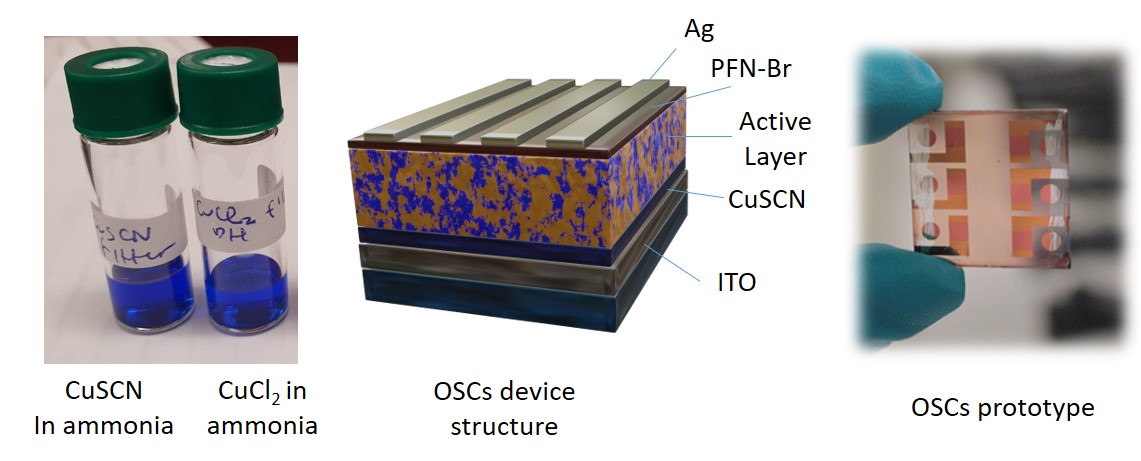
Figure. (left) CuSCN and CuCl2 solution dissolved in aq, ammonia used for hole transport layer (HTL) for OSCs, (middle) Device structure of OSC employing CuSCN as HTL, (right) OSCs device prototype using CuSCN as HTL.
Sivitas Terkait : Shobih, Yuliar Firdaus,