Maritime Communication System Development Aims to Provide the Provision of Broadband Data Services on the VHF Spectrum Band
Cognitive Radio (CR) is present as a solution to the scarcity of frequency spectrum due to the increasing demand for spectrum usage. As is well known, most countries in the world adopt a static spectrum allocation policy. With this policy, each spectrum is allocated to a specific user. Research results in recent years have shown that spectrum use under a static spectrum allocation policy is inefficient. A large portion of the spectrum is not used at a particular time or area, reducing the spectrum utility. As the demand for spectrum allocation continues to increase, this has an impact on spectrum scarcity. CR technology is a breakthrough for improving spectrum utility by dynamically allocating spectrum. In addition to licensed users (PU), unlicensed users (SU) can access certain portions of the spectrum as long as licensed users are not using them.
In this research, CR technology is proposed to improve broadband communication access in the maritime environment. As is known, maritime communications depend on VHF and satellite technology. In the aquatic environment, satellite communication plays a vital role in the provision of data communication services. However, this technology is one of the most expensive technologies. Meanwhile, maritime VHF spectrum bands are allocated for specific services. In addition, maritime VHF technology is a narrowband technology, so it does not support broadband services. However, VHF technology is more prevalent among seafarers and less expensive in cost. VHF communications can propagate far beyond LOS. Implementing CR technology in the maritime VHF frequency band can be a solution for providing broadband communication services in the maritime environment at a much lower cost. In addition, CR is also a solution to the scarcity of spectrum, considering that the spectrum allocation is already quite dense.
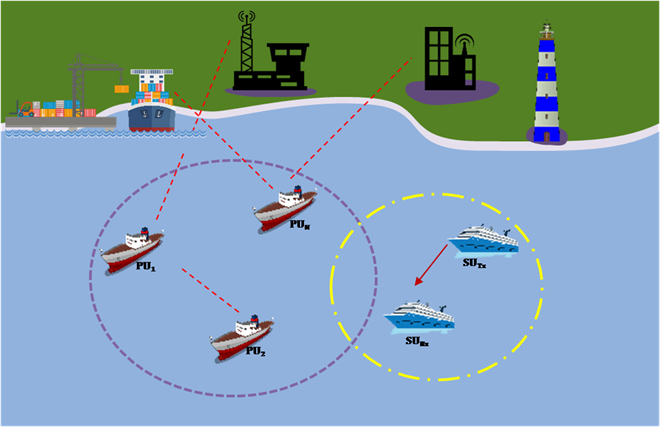
Figure. Cognitive Network Architecture in Aquatic Environments
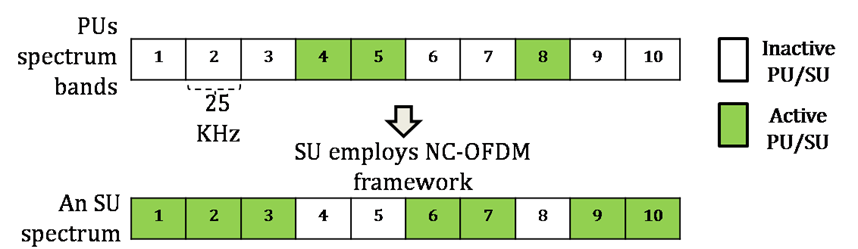
Figure. Spectrum Sharing Mechanism Between Primary User (PU) and Secondary User (SU)
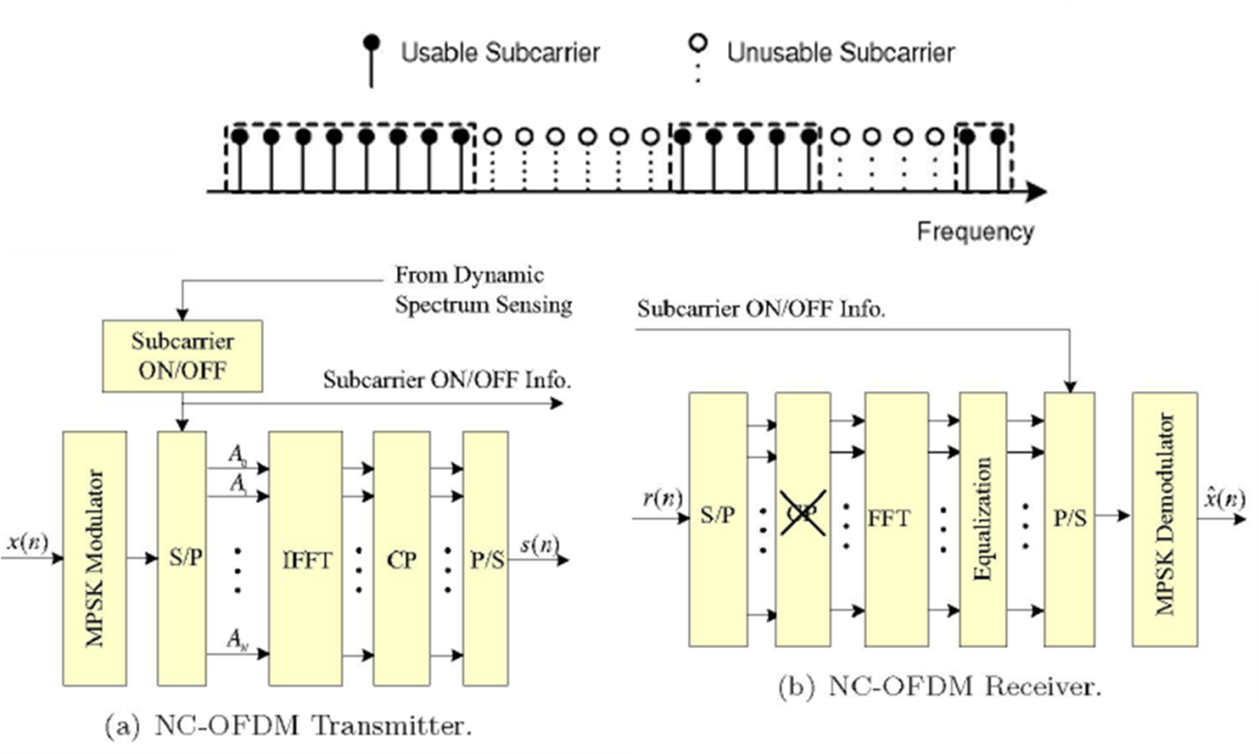
Figure. Block Diagram of NC-OFDM Simulation
Sivitas Terkait : Nasrullah Armi,