
Digging Out Nata de Coco from Coconut Water
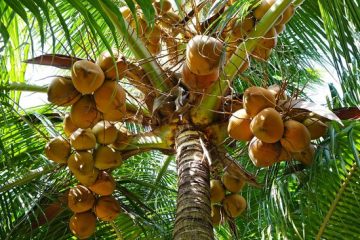
by Feby Fitria Ayu Astuti @febyfitria98
Bandung, CNN Indonesia – Not far from Sasana Budaya Ganesha or mostly known as Sabuga, precisely located at Jalan Cisitu, Sangkuriang, Bandung, stood beautifully built blue buildings. One of the building is called Gedung 50 located in Indonesian Institute of Sciences campus. In this place, I had a chance to meet Indriyati, the person in charge of a research utilization coconut water and biomass waste for environmental friendly material.
The research mainly targets the utilization of coconut water as the host for the acetic acid bacteria which further can be exploited for the production of nata de coco. “We use the coconut water to increase the functional value of the side products, thus, economical values could be gained concomitantly”, said Indriyati during our conversation.
Indriyati said that the biodiversity in Indonesia is remarkably abundant, and coconut is one of them. Coconut is prevalently used as the main material for copra or coconut oil production where only the fruit flesh is taken. Indriyati added, “In copra production, the coconut water is disposed, if it is continuously exposed to the ground, it will lead to the damage of the soil since the coconut water acidity is high.”
The challenges in earth conservation underline the reduction of pollution which leads to the plethora of research on waste application. “Beside coconut water, this research also utilizes liquid waste of tofu and pineapple skin juice with consideration that the mentioned materials are potential to host acetic acid bacteria which further generate cellulose”, said this ITB alumnus.
She also pronounced, “If generally the cellulose is produced by the plants, we offer alternatives from the bacteria. A good host for the bacteria must contain high carbon and therefore, we choose coconut water from old coconut fruits”.
In nata de coco production, beside high carbon content, another required condition entangles high acidity (pH = 4) environment, temperature effects, seeds quality and the presence of other compound such as nitrogen (N).
Still discussing about the bacterial hosting part, Indriyati stated that “From literature review, the carbon content of the materials such as in liquid waste of tofu or pineapple skin juice are known to be considerably low for the bacteria host, that is why sugar can be added intentionally.”
In has been noted too that the most suitable bacteria to grow nata de coco is Acebacter xylinum. While the other bacteria are potential too as long as still classified as acetic acid bacteria group.
This research has been long conducted since 1990s when this research unit was still merged with Research Center for Physics, Indonesian Institute of Sciences. Throughout the program of Riset Unggulan Terpadu in 1996, Research Center for Physics, Indonesian Institute of Sciences initiated the work on nata de coco as the material for accoustic membrane based on the recommendation from Sony, Japan.
“In 2016, we seek innovation and formula to enhance the productivity of cellulose from coconut water and modify the yielded cellulose for food packaging material”, she informed.
Nata de coco, a bacteria-based cellulose, has also been applied in medical field, for instance as bandage or artificial veins. In addition, nata de coco slurry can be processed for paper production. Indriyati also claimed, “We are going to make an edible food layering agent called as edible film”. Edible film had ever been developed by one of the famous candy company in the nation. In this discussion, Indriyati also mentioned the idea of fabricating nata de coco based-sauce bottle for fast food restaurant. On top of that, such a research is environmental friendly since the Gluconobacter xylinus used in this study owns the properties of bioplastics and is biodegradable. (ded/ded)
Published in CNN Indonesia