
Purifying Post-Disaster Turbid Water
Purifying Post-Disaster Turbid Water
By : Kompas
The scarcity of clean water prevalently occurs during disaster. Even in flood condition where the water is abundant, clean water remains a serious problem since the flood water is inconsumable. This scene has dragged enormous attention both from scientists and industrial players to develop innovation in water purifying system.
Disaster Mitigation Organization (Badan Nasional Penanggulangan Bencana (BNPB)), for example, utilizes Indonesian-made water purifier, called as portable water treatment (PWT). Since 2010, the platforms have been distributed to all the Disaster Mitigation Organization operation regions (provinces or cities), one unit per area.
“We prefer to use the simple local product instead of using advanced exported one, however, the result is fantastic! The quality of the water is beyond that of the commercial mineral water‘, stated Harun Sunarso, The head of Subdiresctorate of Restoration and Equipment Maintenance (Subdirektorat Penyimpanan dan Pemeliharaan Peralatan BNPB) on Tuesday (13/12), in Jakarta. Dissolved solid particles (total dissolved solids/TDS) including all minerals, salts and metal dissolved in water normally reach 100 ppm in concentration while the standard quality of TDS for drinking water is 10-100 ppm. “Interestingly, our water purifying system showed the level of the processed water TDS of about 0.01 ppm with the prolonged treatment”, said Sunarso. He assured that the officers must perform the detection with TDS meter prior to distribution to users.
He also added, “The process of rain water and turbid river water which usually contains mud may produce clear and clean water. The most important requirement is, fresh non-salty water use instead of the brackish water or seawater use. It is OK even though the source if from sewage”. A real implementation had been demonstrated during flood disaster hitting Jakarta in 2014. At that time, 5 units of water purifier were functioned by the BNPB together with BPBD DKI Jakarta.
The purifying system consists of 3 parts; an electric generator as power supply, filtration media and a reversed osmosis circuit (reversed osmosis/RO). Water is pumped into the filtration media separated into 3 types of tubes; crude particle filter, fine particle filter with activated carbon, and odor removal tube containing beim (odor remover agent). From this process, the produced clean water is later distributed for domestic usage (MCK) with the capacity of 100 L water/minute.
For drinking water, the water resulted from the filtration media is transferred to the RO loop. In the last stage of RO process, the water is exposed in UV light to eliminate pathogens. Typically, the platform is set to produce about 21 L drinking water per minute with the TDS level of 0.08 ppm. The smaller the produced volume/minute, the better quality is achieved.
The standard electric generator applied by the PNPB has the power of 2.800 Watt. The purifier requires about 20 L of gasoline for 8 hours of operation. Harun affirmed, “The total consumption is around 600 Watt and therefore, the provided 750 Watt is sufficient”.
In addition, the purifying system is portable and easily moved by a small open truck. A complete series of water purifying system costs IDR. 61.000.000. The cost of the delivery of some purifiers to BPBD is covered by the national budget (APBN), yet, some regions preferring additional units may cover the cost with the regional budget (APBD), such as done by Magetan City, East Java.
Nevertheless, some of the BPBD regions were hesitant to use the system in regards with the risk of damage. Since 2013, BNPB has only been able to cover 12 provinces including East Nusa Tenggara (NTT), West Nusa Tenggara (NTB), Gorontalo, Jambi and Central Java for the training of using disaster mitigation devices including this water purifier. Yearly training is scoping three BPBD province representatives, participated also by the representatives from all BPBD city of every covered province.
Another challenges are the turnover of the officials such as rotation and mutation of the government staffs. The people complained that the turnover had slowed down the technology transfer, thus, they really hoped that the lecturing officers and the participants were not changed within 3 years.
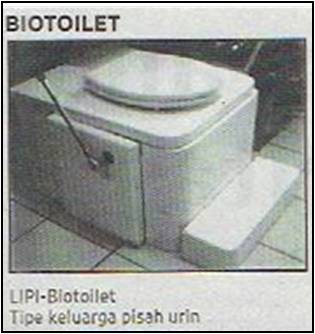
Biotoilet
The clean water crisis typically leads to sanitation problems including the condition when the victims are urged to go to the toilet. One of effective solutions is the development of biotoilet.
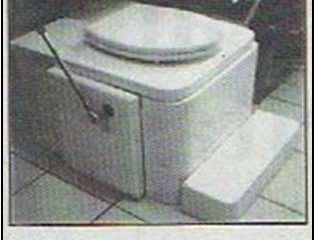
A researcher of Research Unit for Clean Technology, Indonesian Institute of Sciences (LIPI), Neni Sintawardani with her team, since 2000 has been developing biotoilet and septictank-less portable toilet to cut down the use of water. To replace the septic tank, they applied the sawdust or lingo cellulose-based materials to be mixed with the waste.
The porosity of those materials enables the adsorption of liquid or odor as well as hosting the decomposing microbes. With this technique, waste is easily degraded into water and dioxide wastes. After using the toilet, the user has to pull the lever (a flusher in conventional toilet) to mix the waste with the sawdust. After 3 months, half of the mixture is collected and used as compost fertilizer. The sawdust is then re-added into the biotoilet. The biotoilet may accommodate 4-5 people per day.
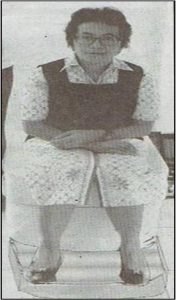
LIPI also developed static pedals to stir the waste with the sawdust. With this idea, the biotoilet capacity is larger, 2-3 families (10-15 people) per day. Sintawardani threw a joke saying “Why not doing exercise after poop?”
Biotoilet is categorized as dry toilet or with zero use of water. Tissues are used to wipe the body part. In Indonesian custom, water is mainly used to clean up the body. The research outcome done by Sintawardani and team underlines that actually less than 0.5L of water for toilet activity per person is enough for sanitation purpose. It is also claimed that the biotoilet had reduced the water usage up to 80% as compared to the use of conventional toilet and is suitable for the application in post-disaster area.
However, a profound research on biotoilet for the disaster victims is needed as the current research done by LIPI still targets the household level usage while the victim camps usually shelter thousands of people.
Published on Kompas hari Thursday. Dec 15th 2016