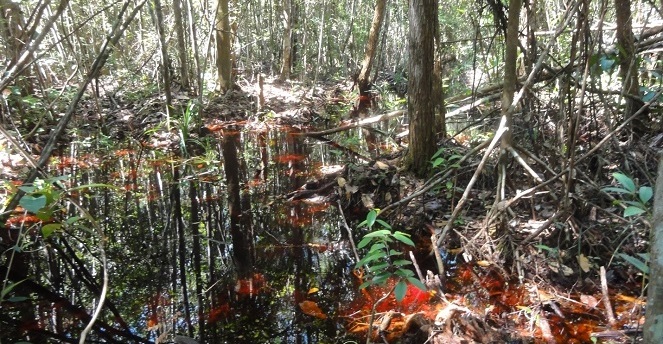
Community Behavior, Management and Water Security: Present and Future
The COVID-19 pandemic that hit Indonesia and the rest of the world affected conditions
related to water, food, and energy and affected the government's ability to guarantee
water, food and energy security nationally, in the new normality period. "It needs
to be structured, governance, and re-coordination to achieve the SDGs target,"
said Dr. L.T. Handoko as the Head of the Indonesian Institute of Sciences (LIPI)
in the Regional Webinar "Water - Food - Energy Security Towards SDGS in New Normal
Era" on Thursday, July 23, 2020.
Handoko said, LIPI as a research and innovation institution was very supportive
in achieving the Sustainable Development Goals (SDGs) targets, especially related
to water, food, and energy. "Through this webinar the media is expected to understand
how the relationship between the three sectors of water, food and energy in achieving
sustainable development targets during and post pandemic," he explained. "LIPI
is one of the first research institutions in the country currently under the coordination
of BRIN and the Ministry of Research and Technology which is always ready to initiate
and facilitate research and innovation to increase the contribution of our nation
in solving various problems related to food, water and energy," he added.
He conveyed that currently LIPI invited all stakeholders to work together by
opening all infrastructure, both human resources and research equipment at LIPI,
which can be used together by academics, government and industry both small and
large. "This collaboration is expected to strengthen research related to these
three things as well as the most important thing is to strengthen the capacity
of human resources and institutions to manage, utilize local resources based on
science and research and develop policies based on science based policy, especially
amid uncertain conditions. during and after the pandemic, "explained Handoko.
Meanwhile Prof. Dr. Ignasius D.A. Sutapa, M.Sc. as Executive Director of the
Asia Pacific Center for Ecohydrology (APCE) said that we are currently facing
challenges and problems in water security, especially in the foreseeable future.
"Climate change will affect five other issues, water conflicts, water pollution,
loss of biodiversity, droughts and floods, lack of clean water and sanitation.
Future conditions in the Asia Pacific including Indonesia will face water stress
until 2040. Water security will be vulnerable if significant efforts are not made,
"he explained
The Research Professor of the Limnology Research Center further explained that
water contributes to the development which varies greatly in various sectors because
almost all are related to water resources. "Currently, the whole world and Indonesia
are affected by COVID-19, this changes people's behavior and water in the future
not only resources but becomes an important asset because it is related to food
and energy so our mindset must be improved in the future," said Ignas.
Ignas added, the water development plan by paying attention to source components,
operator components and consumer components must be discussed in full and in full,
now is the time to act because water resources will affect water quality. "The
concept of ecohydrology is increasingly needed because to integrate ecology, hydrology,
ecotechnology and culture, it must be utilized and synergized to manage water
resources so that all components become our common concern," he said. "COVID-19
has changed a lot of things, including people behavior, consumption adjustments,
priority orders, but most importantly we understand the context of this water
resource is not infinite so we need comprehensive approaches," concluded Ignas.
(Yo ed SL)
WEB STATISTICS
#170,066 since 2017-08-22
 reading APCE UNESCO Category II
 reading APCE UNESCO Category II
 reading APCE UNESCO Category II reading APCE UNESCO Category II reading APCE UNESCO Category II
AFFILIATION
Related UNESCO Category II Centre:
Our network under auspices of UNESCO: